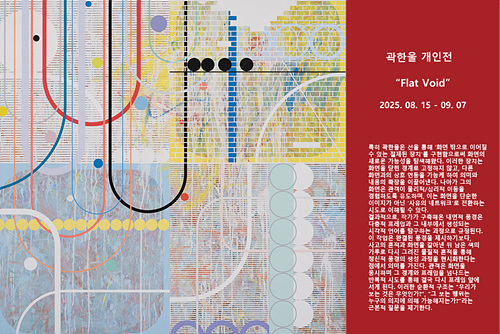
Title : 곽한울 개인전 "Flat Void"
Date : 15th, Aug. ~ 07th, Sep., 2025
Opening : 15th, Aug., 2025 (Fri.) 4 PM
Place : Artertain (Yeonhi-dong, Seodaemungu)
Curator : Heeseung Hwang (+82 (0)2-6160-8445)
선(Line)의 풍경
회화 작업에서 화면 앞에 서는 행위는 단순히 시각적
경험을 탐구하고 표현하는 차원을 넘어, 정신이 이끄는 전혀 다른 세계로의 접속을 시도하는 태도를 내포한다. 현대 사회에서
회화의 화면은 논리적 사고나 감정적 기억을 전달하는 단순한 매개체라기보다는, 오히려 또 다른 시간과 공간을 경험하게 하는
통로로 기능할 때 본래적 의미를 되찾는다. 곽한울의 작업은 바로 이러한 화면의 본질에 대한 자각에서 출발한다. 그는 화면을
또 다른 시공간을 상상하고 그곳으로 도달할 수 있는 가능성으로 인식하며, 그 안에서 형성되는 다양한 관계와 구조를 탐구한다.
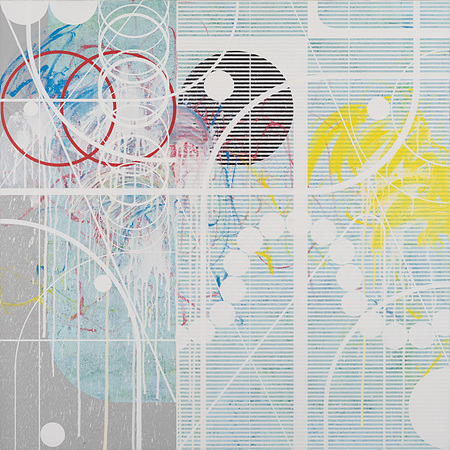
프레임(frame)은 본질적으로 시야를 제한하는 장치이지만, 동시에 집중된 시각 경험을 통해 보다 풍부한 상상을 가능하게
하는 역설적 성격을 지닌다. 작가는 이 프레임의 이중성을 깊이 파고들며, 화면의 ‘내부’와 ‘외부’ 경계를 반복적으로 넘나드는
경험을 제공한다. 그 결과, 그의 화면은 더 이상 고정된 이미지의 경계가 아니라, 사유와 지각을 확장하는 매개로 작동한다.
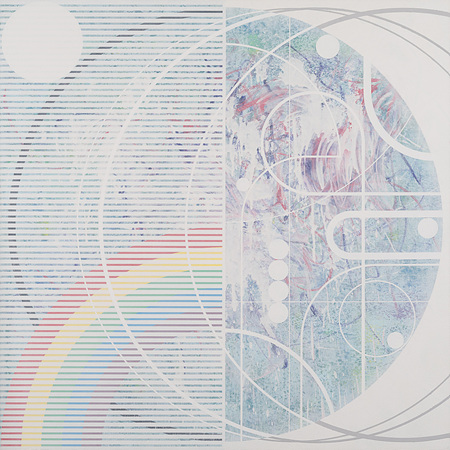
화면 속에서 선(line)은 나타나고 소멸하는 과정을 반복한다. 때로는 질서정연하게, 때로는 불규칙하게 얽히며, 이 선들은
화면의 구조를 형성하는 동시에 해체하는 역할을 한다. 하나의 선을 인식하는 순간 또 다른 선이 어긋나며, 긴장과 이완이 교차하는
시각적 경험이 생성된다. 이러한 선들은 단순한 조형적 요소를 넘어, 작가의 사유 흔적이자 그 이면의 무의식을 드러내는 독자적
시각 언어로 작동한다.
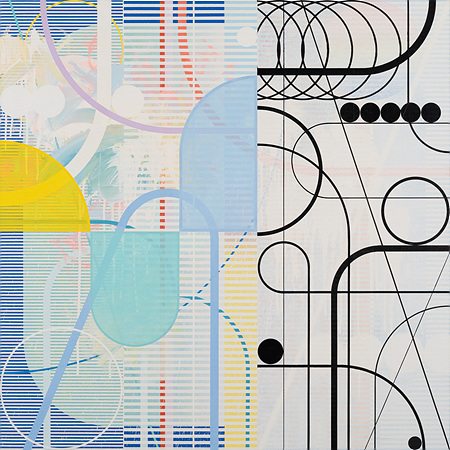
화면 위에 머무는 점(dot)은 움직임과 리듬을 암시하며, 음영은 가변적 공간을 형성한다. 그러나 그 속에는 끝내 소멸하지
못하고 대상화되지 못한 잔상들이 부유한다. 이들은 실체 없는 상태로 남아 있지만, 동시에 인식의 경계에서 작동하며 우리가
알지 못했던 세계를 암시한다. 이는 보는 행위의 한계와 가능성을 동시에 드러내는 지점이기도 하다.
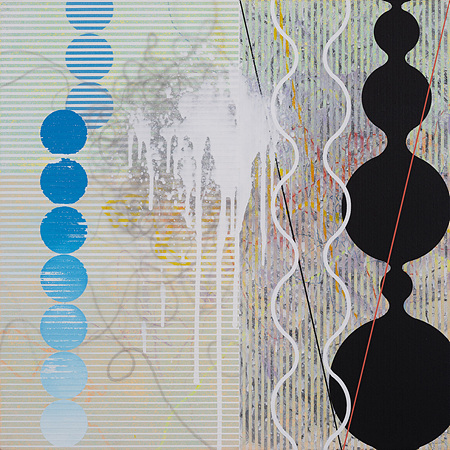
작업의 특정 지점에서 등장하는 얇은 막 혹은 망은 시야를 제한하는 요소로 기능하지만, 이는 완전한 차단이 아니라 오히려 ‘보는
행위의 자각’을 촉발하는 장치이다. 망 너머로 관찰되는 이미지는 고정된 풍경이 아니라, 끊임없이 생성되고 해체되며 확장을
잠재하는 풍경으로 진화한다.
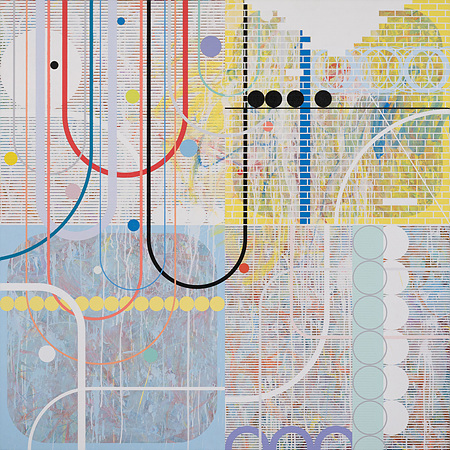
특히 곽한울은 선을 통해 ‘화면 밖으로 이어질 수 있는 절제된 장치’를 구현함으로써 화면의 새로운 가능성을 탐색해왔다. 이러한
장치는 화면을 닫힌 경계로 고정하지 않고, 다른 화면과의 상호 연동을 가능케 하여 의미와 내용의 확장을 이끌어낸다. 나아가
그의 화면은 관객이 물리적/심리적 이동을 경험하도록 유도하며, 이는 화면을 단순한 이미지가 아닌 ‘사유의 네트워크’로 전환하는
시도로 이해될 수 있다.
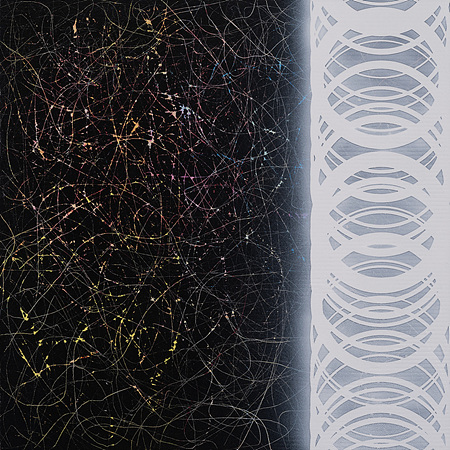
결과적으로, 작가가 구축해온 내면적 풍경은 다층적 프레임과 그 내부에서 생성되는 시각적 언어를 탐구하는 과정으로 규정된다.
이 작업은 완결된 풍경을 제시하기보다, 사고의 흔적과 화면을 갈아낸 뒤 남은 색의 가루로 다시 그려진 물질적 흔적을 통해
정신적 풍경의 생성 과정을 현시화한다는 점에서 의미를 가진다. 관객은 화면을 응시하며 그 경계와 프레임을 넘나드는 반복적
시도를 통해 결국 다시 프레임 앞에 서게 된다. 이러한 순환적 구조는 “우리가 보는 것은 무엇인가?”, “그 보는 행위는
누구의 의지에 의해 가능해지는가?”라는 근본적 질문을 제기한다.
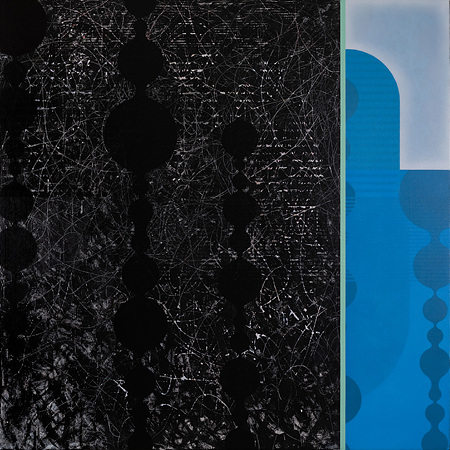
작가의 작업은 모호성 속에서 잠정적 질서를 창출하며, 이를 통해 관람자로 하여금 자신의 시선과 지각의 관계를 성찰하도록 유도한다.
결국 그의 화면은 닫힌 구조가 아닌 열린 가능성의 장으로 확장된다. 선과 점, 그리고 망으로 조직된 화면들이 서로의 관계를
통해 형성하는 감각과 사유의 풍경을 탐구하는 일은, 회화에 대한 새로운 감상의 여정으로 이어질 것이다.
(글. 임대식)
Landscape of Lines
In the realm of painting, the
act of standing before the picture plane extends beyond a mere exploration
of visual perception; it implies a tacit attempt to access an entirely
different world, guided by the mind. In contemporary society, the pictorial
plane regains its original function as painting not when it serves as
a simple conduit for logical thought or emotional memory, but when it
operates as a threshold to another time and space. Hanoul Gwak’s practice
originates from this awareness of the fundamental nature of the pictorial
field. The artist regards the picture plane as a possibility?an imagined
elsewhere?and investigates the diverse relationships and structures
that emerge within it.
A frame, by its very nature, restricts the expansiveness of vision;
paradoxically, however, it enables a heightened concentration that invites
a multiplicity of imaginative engagements. Gwak delves into this duality
of the frame, offering experiences that traverse the boundaries between
the ‘inside’ and ‘outside’ of the image. Consequently, the pictorial
plane no longer remains a fixed boundary of imagery, but rather operates
as a medium for expanding thought and perception.
Within the surface, lines emerge and dissolve in an incessant rhythm.
At times, they appear in orderly sequences; at others, they entangle
unpredictably, constructing and deconstructing the very structure of
the picture. The recognition of one line is immediately unsettled by
the disjunction of another, generating a visual experience charged with
tension and release. These lines function not merely as formal elements
but as traces of the artist’s thought?an autonomous visual language
rooted in the unconscious beneath the act of thinking.
Dots lingering upon these lines imply motion and rhythm, while gradations
of tone evoke mutable spaces. Yet, spectral residues hover across the
plane, resistant to complete erasure and refusing objecthood. They persist
in an indeterminate state, revealing a realm that operates at the margins
of perception?an intimation of the unknown that exposes both the limitations
and the potentialities of vision itself.
Occasionally, a thin membrane or mesh emerges across certain parts of
the work, ostensibly obstructing the viewer’s gaze. Yet this is not
an act of absolute occlusion; rather, it functions as a device that
provokes a heightened awareness of seeing. The image beyond the mesh
does not constitute a resolved landscape, but an evolving terrain?continuously
generated and dismantled, harboring latent possibilities of extension.
Of particular significance is Gwak’s pursuit of “a restrained device
that extends beyond the pictorial frame”, through which he explores
new horizons of painting. These devices liberate the frame from its
closed condition, enabling its interaction and resonance with other
pictorial planes. His installations invite the viewer into a dynamic
experience of physical and psychological movement, transforming the
frame from a sealed boundary into a network of thought.
Ultimately, Gwak’s practice can be understood as an investigation into
the visual language born within multilayered frames?an endeavor that
foregrounds not the presentation of a completed image, but the process
of formation itself. The material residues of thought?whether in the
traces of erasure or in pigments ground into powder and reconstituted?become
the very evidence of an evolving mental landscape. In repeatedly confronting
and traversing the frame, the viewer is returned to the threshold once
more, caught in a cycle that poses fundamental questions: What is it
that we see? And by whose agency is the act of seeing made possible?
Gwak’s works articulate a provisional order within ambiguity, prompting
viewers to reflect on the relational dynamics between their gaze and
perception. His pictorial landscapes of lines do not assert closure,
but instead open onto fields of possibility. The interplay of lines,
points, and veils across these planes creates a network through which
new sensorial and conceptual terrains may be explored?inviting a renewed
journey into the experience of painting itself.
(Text by Gustav Daishik Yim)
|
